Product Description
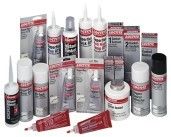
Loctite Gasketing Products
LOCTITE anaerobic Gasketing products act as both an adhesive and sealant between two flanges. The liquid sealant completely fills the space between the flange surfaces, thereby preventing the escape of fluid materials or gases in composite machine parts or pipe connections. At the same time, adhesion to the flange surfaces enhances the strength of the assembly.
LOCTITE flange sealing products are applied as liquids, allowing them to fill and seal imperfections on metal flange surfaces. These sealants cure in the presence of metal and the absence of air to form a durable seal between components, with maximum face-to-face contact. LOCTITE flange sealants also eliminate corrosion and provide instant low-pressure seal on assembly. After full curing LOCTITE flange sealants will not shrink, crack or relax and they resist displacement better than conventional gaskets.
|
Features
|
Products
|
|
High Temperature
|
LOCTITE 510
|
|
Flexible
|
LOCTITE SI 5970
|
|
LOCTITE 5188
|
|
High Strength
|
LOCTITE SI 5699
|
|
LOCTITE 574
|
Reliable Sealing Solutions for IndustriesLoctite Gasketing Products provide secure and enduring seals perfect for high-demand industrial environments. Their liquid formulation allows easy application and conformity to uneven surfaces, reducing maintenance needs and downtime. Trusted by manufacturers and maintenance teams, these gasketing adhesives are a staple for heavy machinery, automotive assemblies, and processing plants.
Optimized for Performance and EfficiencyEngineered with 97% purity, Loctite Gasketing Products offer superior performance and minimal contamination risk. Their formulation is optimized for maximum adhesion and flexibility, ensuring equipment runs smoothly under extreme conditions. The industrial-grade quality guarantees durability and effectiveness for prolonged periods, supporting efficient operations in factories and workshops.
FAQ's of Loctite Gasketing Products:
Q: How should Loctite Gasketing Products be applied in industrial settings?
A: Loctite Gasketing Products should be applied directly to clean, dry surfaces. Simply dispense the liquid adhesive along the desired sealing area, assemble the parts, and allow it to cure as per the product instructions. This process ensures a reliable seal that can adapt to surface irregularities for industrial applications.
Q: What makes Loctite Gasketing Products suitable for industrial use in India?
A: These products offer industrial-grade strength, a high 97% purity formulation, and excellent chemical resistance, making them ideal for demanding work environments common in Indian industries. Additionally, they are readily available through local distributors, suppliers, and traders across the country.
Q: When is it recommended to use a liquid gasketing adhesive over traditional gaskets?
A: It is advisable to use Loctite Gasketing Products when you require superior conformity to surface irregularities, quick application, and a contamination-free seal. They are particularly beneficial in applications with complex joint designs or where thermal or mechanical stress is prevalent.
Q: Where can I purchase Loctite Gasketing Products for industrial projects in India?
A: You can acquire these products through certified distributors, suppliers, and traders across India. Many industrial supply companies and authorized Loctite partners stock these adhesives, making them accessible nationwide.
Q: What benefits do Loctite Gasketing Products offer over conventional gaskets?
A: Loctite Gasketing Products provide seamless, leak-proof seals that are resistant to vibration, chemicals, and high pressure. Unlike traditional gaskets, their liquid state allows them to form a uniform barrier, reducing the risk of leaks and simplifying installation.
Q: How does the high purity (97%) of these products enhance their performance?
A: The 97% purity ensures minimal impurities, enhancing adhesive consistency and reliability. This translates to stronger bonds, improved sealing, and longer equipment life, particularly in demanding industrial environments.






 Send Inquiry
 Send Inquiry
 Send SMS
